Keywords
Scrim
Moiré
Printed matter
Materiality
Practice-based research
Japanese paper
CMYK
How to Cite
Abstract
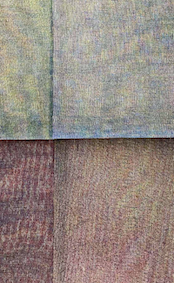
peripheral acts (2023-ongoing) is a body of 30 monoprints on Japanese paper. Created as part of my practice-based doctoral project, Obdurate matter? Unfolding potential in materials, apparatuses, and procedures of printmaking through speculative practice (2021-2025), at Edinburgh College of Art, the series of prints explores the possibilities held within the repeated printing of scrim fabric in CMYK formation.
Through instances of visual, material, and processual variation – apparent in each print's differing colour, tone, and moiré patterning; in impressions of scrim's irregular and fluid weave, and moments of human error – the works draw out and attend to the ways in which unanticipated, and perhaps even unwanted, variation within repetitive printerly acts can prove to be generative. Positioned in the context of the printed 'error', the perceived awkwardness and discomfort in such interfering factors are presented as both practical and conceptual thresholds where inherited conventional perceptions can be renegotiated.
In this text, I consider how my choice of substrate for peripheral acts – tosa washi paper – serves to extend the themes and position outlined above. Through examination of the paper's materiality, physicality, and behaviour, between contexts of the print workshop, the artist's studio, and the exhibition site, I explore how the works unveil the liveliness of printed matter.
This discussion draws from theories of 'the fold' (Deleuze 1993; Marks 2014), in addition the field of new materialism and the works of Barad (2007), Bennett (2010), and Coleman, Page, and Palmer (2019) to speculate as to how print matter can come to unfold in practice. It seeks to uncover a new or overlooked printerly vibrancy, and consider the possible effects of this approach in the context of contemporary printmaking and the expanded field.
References
Alldred, P. and Fox, N. (2022) New Materialism. London: SAGE Publications Ltd. Available at: https://doi.org/10.4135/9781526421036768465. (Accessed: 31/04/2024).
Barad, K. M. (2007) Meeting the universe halfway: quantum physics and the entanglement of matter and meaning Durham: Duke University Press.
Bennett, J. (2010) Vibrant matter : a political ecology of things. Durham, [N.C: Duke University Press.
Coleman, R. (2019) ‘Glitter: A Methodology of Following the Material’, MAI: Feminism & Visual Culture, 15 May. Available at: https://maifeminism.com/glitter-a-methodology-of-following-the-material/ (Accessed: 4/10/2024).
Hight, C. (2009) “The Moiré Effect in Architecture” in Spuybroek, Lars. Research & design : The Architecture of Variation / edited by Lars Spuybroek. London: Thames & Hudson. pp. 19-25.
Ingold, T. (2013) Making : anthropology, archaeology, art and architecture. London ; Routledge.
Kontturi, K.K. (2018) ‘Following’, New Materialism – How Matter Comes To Matter. Available at: https://newmaterialism.eu/almanac/f/following.html.
Marks, L.U. ‘Enfolding-Unfolding Aesthetics, or the Unthought at the Heart of Wood’ (2014) in Technology and Desire: The Transgressive Art of Moving Images. Eds. R.Gaafar and M. Schultz. Bristol: Intellect Books.
Roberts, J.L, (2021) ”Interference” in Contact: Art and The Pull of Print.[online lecture series] Available at: https://www.nga.gov/research/casva/meetings/mellon-lectures-in-the-fine-arts/roberts-2021.html. (Accessed: 07/10/2021).
Roberts, J.L. (2024) Contact : art and the pull of print. Princeton: Princeton University Press.

This work is licensed under a Creative Commons Attribution 4.0 International License.
Copyright (c) 2026 Miriam Hancill