Keywords
Intertwinement
Dust
Image technologies
How to Cite
Abstract
This paper examines the relationship between image, material, and human perception through the intersection of printmaking, imaging technologies, and scientific inquiry. As an image-maker, I consider every image to be in collaboration with paper — whether as a support for drawing, print, or digital image. Paper does not merely hold the image but actively informs and transforms it. This relationship is continually shifting, producing meaning through touch, weight, and surface.
This research explores how images might not simply depict the world but express how we see through it — how perception itself can be materially embodied to speak about something unspeakable, about the shadow and weight of material and time.
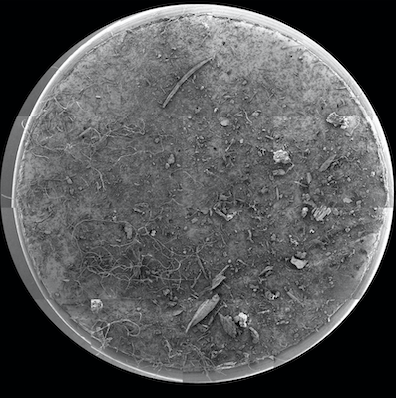
Working with a fifteenth-century reliquary—a unique devotional object containing fragments of bone and, remarkably, its own gathered dust, a series of artworks intertwine technologies of imaging across art and science to push this relationship to extremes. Small bound paper books and large double sheets become experimental sites where printed and laser etched images and material intertwine; images appear upon, beneath, and within paper, suspended, as if caught somewhere between a cobweb and a fossil.
Rooted in long-term interdisciplinary research around the subject of dust, the paper situates this practice within projects developed with the Natural History Museum, London, and Kloster Bentlage Museum in Germany. These projects investigate how microscopic imaging and print processes can evoke the emotional and temporal charge of materials and the weight of time.
By positioning printmaking as a site where art and science converge, this paper proposes that image and material co-produce knowledge: to propose ways of understanding the complexities of the world through its most delicate and elusive material forms.
References
Amato, J. A. (2000) A History of the Small & the Invisible. Berkley, Los Angeles & London: University of California Press.
Victor Burgin cited in Lutz Koepnick (2014) On Slowness: Toward an Aesthetic of the Contemporary. Columbia University Press.
Dillon, B. (2009) A Dry Black Veil. Cabinet Magazine Issue 35, Dust Fall 2009. [Internet] Available online at www.cabinetmagazone.org/issues/35/dillon.php.
Flusser, V. ‘Into the Universe of Technical Images’, trans. Nancy Ann Roth (Minneapolis & London: Univer¬sity of Minnesota Press. 2011), 15.
Grazioli, E. (2004) La Polvere nell’arte. Milano: Bruno Mondadori.
Focillon, H. (1989) In Paterson, M. (2007) The Senses of Touch: Haptics, Affects and Technologies. Oxford & New York: Berg.
Bas. van Fraassen B.C. (1999) The Manifest Image and the Scientific Image. In: Aerts D., Broekaert J., Mathijs E. (eds) Einstein Meets Magritte: An Interdisciplinary Reflection on Science, Nature, Art, Human Action and Society, vol 1. Springer, Dordrecht. [Internet] Available online at https://www.princeton.edu/~fraassen/abstract/MANIFEST.pdf
Fried, S. J. and Rosenberger, R. (2021) Postphenomenology and Imaging: How to read technologibidy. Lexington Books.
Holmes, H. (2001) The Secret Life of Dust: From the cosmos to the kitchen counter, the big consequences of little things. New York: John Wiley & Sons.
Idhe. D. in: Fried, S. J. and Rosenberger, R (2021) Postphenomenology and Imaging: How to read technology. Lexington Books.
Koepnick, L. (2014) On Slowness: Toward an Aesthetic of the Contemporary. Columbia University Press.
Lyotard, J. F. (1991). The inhuman: reflections on time. Stanford, Calif.: Stanford University Press.
Merleau-Ponty, M. (2002) The Phenomenology of Perception. London & New York: Routledge.
Sellars, W. (1963) Science, Perception, and Reality. New York: Humanities Press.
Steedman, C. (2001) Dust. Manchester: Manchester University Press.
Wittgenstein, L. (2007) Tractatus Logico-Philosophicus. New York: Cosimo.

This work is licensed under a Creative Commons Attribution 4.0 International License.
Copyright (c) 2026 Johanna Love